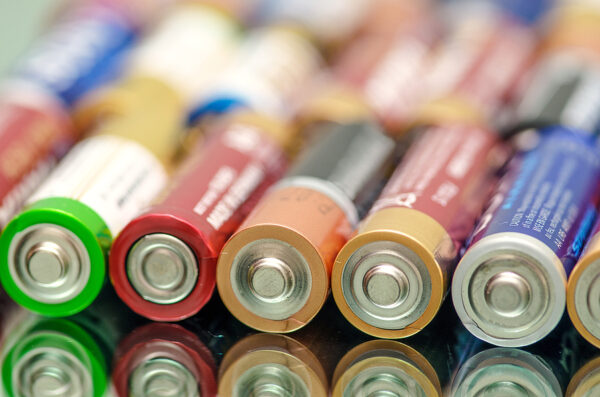
It’s not that long since it was common practice to toss batteries into the trash. In some states, this is still the general rule. Across the country, battery recycling is moving from an afterthought to essential infrastructure.
Each year, consumers, business owners, and employees throw away batteries rather than recycle them. The EPA estimates that 30,000 tons of lead-acid batteries end up in landfills. That’s just vehicle batteries. You must also consider single-cell, lithium, and many other types of batteries.
- Less than 5% of lithium-ion batteries in small electronics are properly recycled.
- 2.11 billion alkaline batteries are disposed of before they’re fully drained of energy.
- After the passage of alkaline battery recycling legislation in Canada and the EU, recycling rates reached 10.15% and 13.6%, respectively.
In 2014, Vermont became the first U.S. state to require the recycling of alkaline batteries. Rechargeable batteries were added to this recycling law in 2024. Although the state’s haulers do not collect these batteries curbside, drop-off locations are available at many hardware and home improvement stores and at all municipal recycling facilities.
More states are taking this approach to battery disposal. It’s a measure of safety for communities given the number of fires triggered by damaged lithium-ion batteries. It’s also important for today’s infrastructure as the focus shifts to renewable energy.
Why Recycling Is Part of Today’s Infrastructure?
Most people think of infrastructure as the power needed to have electricity in their home or workplace. It’s the water you use for showers, cleaning, cooking, and drinking. It’s the roads you take to get from Point A to Point B and back. It’s the method used to heat or cool your home. It’s the phone, cell, internet, and possibly cable TV you rely on every day.
Batteries are also a vital part of the infrastructure. They’re in the phones, tablets, and laptops you use for entertainment, daily living, and work. With the shift away from paper tax filings, tax payments, and paper checks, a computer is essential.
Solar panels and wind power often include battery storage to hold excess power for unexpected outages. You have batteries in your smoke, fire, and carbon monoxide detectors. Batteries are in your vehicle. They’re in the mass transit you use for work commutes or vacations. They’re even in items like your electronic deadbolt, doorknob, garage door opener, or security cameras. Batteries are essential.
It’s not just people, either. Lithium-ion batteries are found in data centers, defense systems, industrial settings, and power grids. All these key areas of the digital infrastructure have made battery manufacturing busier than ever. The global lithium-ion battery market increased by more than 20% between 2024 and 2025. Lithium-ion battery consumption has increased 600% since 2020. Demand is outpacing supply, and that’s a problem.
1. The Value in Materials RecoveryBattery production requires six key components, and many are mined in other countries:
- Cobalt – Comes mainly from mining copper and nickel, and more than 70% of the byproduct is produced in the Democratic Republic of Congo.
- Copper – Mined in countries like Chile, China, the Democratic Republic of Congo, Peru, and the U.S.
- Graphite – Mined alongside metamorphic rocks, Brazil, China, India, Madagascar, and Mozambique are the largest producers.
- Lithium – Extracted from salt brine or hard rock. Australia is the largest producer of lithium from hard rock, while Chile is the largest producer from brine.
- Manganese – This element comes from marine rock deposits. The top producers are Australia, Brazil, China, Gabon, and South Africa.
- Nickel – Mined from the earth’s crust. The largest reserves are in Australia, Canada, China, Indonesia, and Russia.
Many of these items are not mined in the U.S., leaving people at the mercy of prices set by other countries in response to tariffs and demand. Some were, but pollution is still a problem. A copper mine in New Hampshire was abandoned in 1915. That mine continued to discharge water high in cadmium, copper, and zinc into local waterways. Mine cleanup reduced hazardous metals by 80%, but levels remain unsafe in downstream areas.
Recapturing materials through battery recycling reduces the need for mining. Instead of stripping the earth of these raw materials, batteries are recycled safely at facilities specializing in battery recycling. Those reclaimed materials go into new batteries and electronics, ensuring supply without compromising environmental and community safety.
2. The Cost of FiresOne of the best reasons to recycle is the risk of fires caused by damaged lithium-ion batteries. The EPA examined 64 materials recovery facilities (MRFs) across the U.S. from 2013 to 2020. Those 64 MRFs experienced 245 fires in those 7 years.
- 22% reported injuries from lithium-ion battery fires.
- 39% dealt with service disruptions.
- 43% of MRFs that experienced a fire incurred a monetary loss.
- 78% had to call emergency responders at least once.
When there is a fire, the smoke doesn’t stay contained. It enters communities where people with health conditions like asthma are at risk. The fire can spread to other buildings. It increases taxes by affecting recycling, trash collection, and management.
3. National Energy SecurityIt’s clear to many that clean energy sources are important. About 82% of the U.S.’s total energy comes from fossil fuels. It’s estimated that there’s potential for 463,000 TWh of renewable energy that’s not being utilized. People are increasingly recognizing the value of wind and solar energy, as well as hybrid or electric cars.
As people turn to renewable energy sources, battery consumption is outpacing production. If something doesn’t change, estimates are that by 2030, to meet current demand for batteries, the world needs:
- 12 new graphite plants
- 21 new manganese plants
- 26 new cobalt mines
- 28 new nickel mines
- 28 new rare earth mineral mines
- 31 new graphite mines
- 33 new purified phosphoric acid plants
- 52 new lithium mines
- 61 new copper mines
More plants and mines mean more jobs, right? The problem is that you cannot create a new plant or mine in such a short time. It can take decades to get plants planned, permitted, built, staffed with trained workers, and running at full capacity.
Just for plants manufacturing anodes, cathodes, and cells to run at capacity, it would take five years. Time is of the essence, which is why reclaiming materials from spent batteries is essential to the infrastructure.
Battery Recycling Frameworks in Place Across the U.S.
Not every state mandates battery recycling, but these do.
- California – Recycling fee paid when purchasing battery-embedded products like smartwatches.
- Illinois – Manufacturers fund recycling through stewardship programs. Consumers drop off batteries in collection bins at retailers like AutoZone and The Home Depot, or at MRFs.
- New York – Requires manufacturers to take back batteries from items they sell in the state.
- Vermont – All batteries are recycled through collection bins in retailers and at MRFs.
- Washington – Manufacturers must join an organization that funds and operates collection sites, or their products will be banned from the state.
Before you drop off batteries for recycling, check the rules. Many drop-offs ask that you place a piece of electrical tape over the terminals.
Where to Go for Battery Recycling
Recycling batteries, whether you’re a business or a household, is more than the right thing to do for the environment. It’s a necessary step in closing the loop and supporting modern infrastructure. It’s time to stop wasting vital resources when so many of the materials used to make new batteries and electronics are found in the devices we no longer use because of age or disrepair.
Battery recycling is easier than you’d imagine and is important. Look for battery drop-off locations at local hardware or home improvement stores, such as Lowe’s or Home Depot. Check your district’s recycling facility to see which battery types are accepted and where to drop them off.
Reach out to ERI if you’re a business seeking battery recycling and ITAD services, or if you want to save time by shipping batteries back to our facility for safe, effective recycling.