Streaming services like Apple Music, Spotify, and YouTube Music are extremely popular today. Some have shifted from full stereo systems to smart speakers. However, that means many homes and businesses have stereo equipment tucked away.
The longer a record player, speakers, tape decks, cassette players, and other components sit around, the easier it is to forget them. Given everything found within old and new stereo equipment, forgetting them in a basement, garage, storeroom, or storage locker isn’t ideal. Stereo recycling is essential for homeowners and business owners.
What’s In a Stereo?
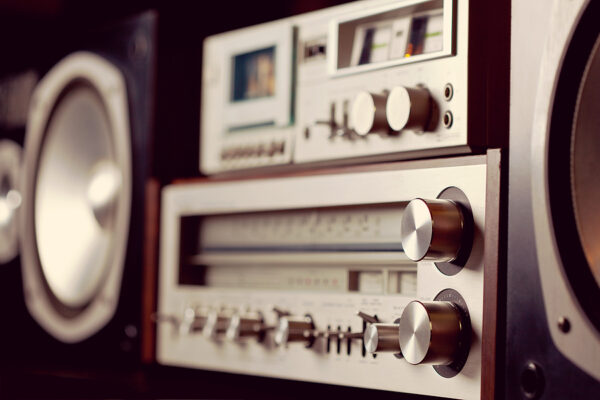
The components in your stereo varied. If you purchased individual components to fit in your cabinet, you’d often have:
- 8-track players
- AM/FM tuners
- Cables
- Cassette decks
- CD changers
- Graphic equalizers
- Power strip
- Preamplifier
- Speakers
- Speaker wires
- Turntables/LP Player
Some preferred to purchase an all-in-one system. This was convenient, but if any component failed, the entire system had to be replaced.
Within all those components, glass, metals, plastics, polymers, and wood are part of the manufacturing process. We’ll start with metals, as lead was a common solder alloy used in the circuit boards of older stereo systems. As lead was phased out, tin became more common. Other metals include:
- Aluminum – Front panels, internal heat sinks, and knobs
- Brass – Hardware and mechanical connectors
- Copper – Circuit boards, transformers, and wiring
- Gold – Plating on connector terminals
- Silver – Relay contacts
- Steel – Outer casing
Older systems might not have as much plastic as newer ones, but it’s still a material that should be recycled when possible.
- Acrylonitrile Butadiene Styrene (ABS or #7 Other) – Enclosures, faceplates, and knobs
- Nylon – Cable ties and insulators
- Phenolic Resin (Epoxy) – Substrate on printed circuit boards
- Polycarbonate (PC or #7 Other) – Display windows and indicator lenses
- Polystyrene (PS or #6) – Internal components and speaker cones
- Polyvinyl Chloride (PVC or #3) – Insulation on the different cables and wires
The stereo rack cabinet is often made of wood, though some newer ones might be plastic or metal. Some have glass doors with magnetic latches. All of that can be recycled and put to good use to create new items. Crushed glass is frequently used as aggregate in paving jobs.
Why Recycle? When Is Repairing Best?
Why should you recycle vs. repair? The Hi-Fi system market is seeing growth with the increased popularity of vinyl. The 2025 market for stereo systems and components neared $28.5 billion. Bose, Sony, and Yamaha are popular brands, but there are many others. With systems in high demand, isn’t it better to give them away or sell them?
Because there is plenty of demand for stereo systems and the components that go into rack systems, repairs should be a priority. High-quality components from big names like JBL, Pioneer, and Technics are immensely popular and often sell for hundreds of dollars if they’re working. They’re still sought by DIYers who want to restore them.
Whenever possible, check if there is interest in refurbished stereo systems. You need to ensure that’s what’s happening, however. For years, electronics collected for recycling ended up in the Agbogbloshie Scrapyard in Ghana. It’s estimated that the unregulated scrapyard received around 15,000 tons each year.
While that provided jobs for area residents, the jobs were low-paying, and no safety measures were in place to protect workers and nearby communities. Cables were burned openly to remove the plastic coating from the copper wires. Items ended up in the area waterways. Instead of working with agencies to make important improvements, the government decided to demolish the site.
When a new president took office, e-waste recycling practices improved. Communities are working on resolving air pollution issues. That’s why it’s so important to understand what happens to your electronics after you drop them off for recycling.
If you partner with ERI, our electronics recycling process begins by valuing items. We aim to refurbish items as often as we can and only recycle items if they are too damaged or irreparable. At that stage, we recycle the components and make sure they re-enter the manufacturing stream in a way that safeguards our workers and the environment.
Not every older stereo system is salvageable. In that case, you want items to be properly recycled. Take the time to ensure that any components and accessories are recycled correctly, not just packaged up for another country to deal with.
Newer stereo systems often have smart technology that stores passwords and login credentials. If you have any smart devices, you need to be careful how they’re recycled. You don’t want someone getting access to your internet account or streaming services.
A Guide to Proper Recycling of Home or Business Stereo Equipment
You’ve organized your stash of stereo components and equipment. How do you ensure it’s properly recycled? Our guide helps you navigate the process.
Prepare Your Stereo Equipment
Start by sorting your equipment so that you can recycle it appropriately.
1. Assess the BrandIf you have some of the most popular brands, they might be worth money. Look for an e-waste recycler like ERI that helps you recover as much value as possible from parts and systems.
If it’s not a big-name brand but works well enough, consider donating it to an organization like Goodwill or Habitat for Humanity’s ReStore.
Separate the potentially valuable from the rest before you decide what to do next.
2. Check RemotesIf your system comes with a remote, remove the batteries before you prepare anything for drop-off. Batteries need to be recycled separately. If a remote or controller has a rechargeable battery, that must be recycled safely. Lithium-ion batteries are a fire risk if damaged by recycling equipment.
Bring batteries to a battery-recycling drop box at your local recycling facility or to a retailer like Home Depot or Lowe’s.
3. Protect Your PrivacyOlder systems don’t store personal information, but some newer ones do. If you have smart speakers or other smart stereo systems, they may have stored passwords for your Wi-Fi and internet.
They might also have usernames and passwords for music streaming services. You need to perform a factory reset. Often, there’s a button you push or a pinhole with a button that’s accessible if you use a needle or paperclip.
4. Box Items by Drop-Off LocationNow that you know what to recycle and what to donate, make sure to separate them. Include cables with the appropriate device, especially if you’re donating it.
Move the donation box directly to a vehicle or arrange for pickup if that option is available in your area. You’ll have it with you the next time you go out.
The recycling box you have should be taken to an authorized e-waste recycling company. Look for a company certified with eStewards, NAID AAA, and R2. This ensures that the items are processed in the U.S. in an environmentally friendly way.
Consider purchasing an electronics recycling box from ERI. Fill it up, ship it to one of our secure facilities, and we handle the rest. We have battery recycling boxes, too. Enjoy knowing you’ve done your part without leaving your home or office.