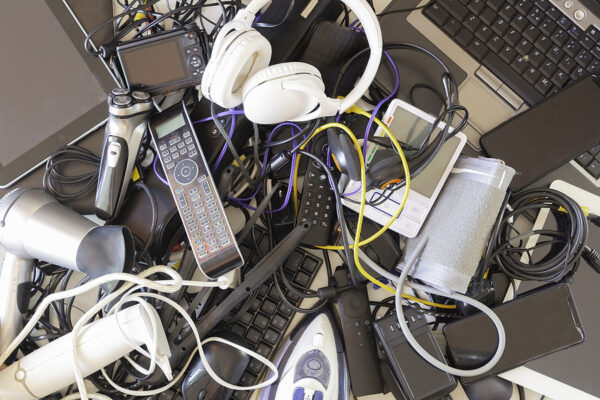
In the past, businesses used a linear model of Buy, Use, Dispose. Sometimes, Build/Make was added to it for businesses that have IT departments that build computers from carefully sourced parts. Either way, new computers, tablets, servers, and other electronics get replaced every three to five years. All of the old electronics create a lot of e-waste.
If you’re still creating end-of-life plans for your electronic equipment once it’s no longer needed, you’re making a mistake. True circular IT begins before you even buy your office equipment.
Chief Information Officers (CIOs) and Chief Sustainability Officers (CSOs) are key members of a team developing a comprehensive plan that integrates data security protocols, remarketing, material recovery, and lifecycle management. They can’t do it alone.
ERI excels in circular IT protocols. Partner with our IT Asset Disposition (ITAD) specialists and build a circular IT program that focuses on value retention, data security, longevity, and zero waste. Our guide helps you minimize your environmental impact when decommissioning old IT equipment.
A Circular Economy Is More Than Recycling
What comes to mind when you hear the term “circular economy?” Many business owners think of it as recycling responsibly. It’s so much more, starting with the items you purchase. A careful consideration of the circular economy assesses:
- The brands/models you purchase, focusing on manufacturers who lower their carbon footprint and use recycled materials.
- How long you use those electronic assets.
- How to reuse them before sending them for recycling.
- How to preserve the value of electronic assets by refurbishing and recycling to recover raw materials that go back to manufacturing facilities.
When IT leaders make purchasing decisions without considering the long-term implications, they create several issues for IT asset management.
- Depreciating Values: It’s a habit to put unused or broken IT assets in a storage closet or storeroom. When they build up to unmanageable levels, you then take steps to recycle them. While they sit untouched, they’re losing value. You could have recycled them while they still qualified for refurbishing programs and recaptured some value.
- Failing to Consider Modular Designs: When you buy proprietary IT assets, you cannot easily repair or upgrade months or years later. Your business is growing, and your office staff needs a faster hard drive. If you’ve invested in computers that cannot be upgraded, you’re forced to buy new.
- Ignoring Data Sanitization Requirements: Buying storage devices or embedded memory that lacks standardized, audit-compliant data destruction protocols, or failing to have clear data destruction protocols in place, raises your risk of a breach or theft. It’s especially critical during decommissioning, as you risk violating regulatory requirements such as the GLBA or HIPAA.
- Meeting Scope 3 Carbon Emissions: Many businesses are required to report and meet Scope 3 emissions targets if they operate in certain regions. It’s more than tracking your own emissions. You must also report the emissions associated with product deliveries to and from your company.
How to Build a Circular IT Ecosystem
Every business has unique needs for a circular IT ecosystem. A medical practice has different requirements than a department store. The basic steps are always the same, however.
Phase 1: Pre-Procurement Planning
Before you purchase IT assets, your procurement team must carefully evaluate the hardware. Purchase price isn’t the only consideration. You need to consider several factors.
- Inventorying: Keeping records of the items you own, including their make/model and serial numbers, makes it easier to track them and their values now and in the future.
- Purchasing: When supporting a circular economy, look at refurbished electronics. You save money and help ensure electronics last a long time. Another option is to purchase items made with as many recycled materials as possible.
- Repairability: Can you repair assets if they stop working? Building computers using modular components makes it easier to upgrade items as needed.
- Resale value: How well does the manufacturer and brand hold its value?
Phase 2: Optimizing the Lifespan and Cascade Deployment
The new equipment arrives. Now is the time to take steps to maximize the lifespan of each computer, tablet, phone, printer, and other devices. When you can increase the time it’s with you by even a year, you save money. One of the best ways to do this is by using cascade deployment strategies.
Instead of giving everyone in your company a new desktop computer, stagger them over time. Your graphic design team needs updated systems more often than the receptionist who spends most of the day on a spreadsheet or word processing program.
The computers that you’re replacing in the graphic design offices are still fully functional. They could be refurbished and deployed to the receptionist. Everyone gets newer equipment, and you’re using your IT assets for as long as possible. Follow this cascade deployment schedule.
- Tier 1: Heavy use in departments like data analytics, media creation, and software engineering. Replace computers and other devices every two or three years.
- Tier 2: Standard use in departments like administration or mail rooms. Refurbish Tier 1 equipment and reassign to Tier 2 users.
- Tier 3: Low usage in departments like the digital signs in a waiting room or automated phone answering system that only handles a few calls per day. Tier 2 devices are reassigned to low-usage departments.
While extending service life is important, you shouldn’t hold onto IT assets longer than is economically feasible. If you’re spending 10 hours a week trying to get a system running smoothly again, you’re wasting money. It’s time to decommission that electronic device and invest in a new one.
If you keep your old assets longer than you should, you risk having components fail at the worst possible time, causing data loss that impacts your business. Batteries that don’t charge and start to swell increase the risk of a lithium-ion battery fire.
Phase 3: Secure ITAD and Value Recovery
Do you worry about data security when you hand over your IT assets for recycling? You’re not alone. It’s a leading reason why business owners store end-of-life hardware in a secure storeroom or send it directly to companies for shredding, even if it still has value.
ERI offers on-site data destruction to help you with peace of mind when maximizing the value of your electronics. With our ITAD programs, we offer:
- NIST-800-88 Data Destruction and Compliance: We hold the highest certifications in the industry and offer on-site or off-site data sanitization in accordance with NIST 800-88 standards. If a higher level is needed, we make it happen. Real-time GPS tracking for chain of custody is also provided.
- Refurbishment and Remarketing: After data sanitization, our technical team tests equipment to determine its potential value. If it’s still usable, repairs and refurbishment are carried out. You recover some of the money you paid.
Phase 4: Urban Mining and Materials Recovery
Not every IT asset qualifies for repair and refurbishing. When that happens, items go into giant shredders. From there, plastic, metal, and glass are processed and reused to make raw materials in manufacturing plants.
ERI’s Carbon-Neutral Processing Facilities
ERI operates multiple state-of-the-art processing facilities across the United States. Combined, the electronics recycler and ITAD specialist processes more than 1 billion pounds of electronic waste annually. We also maintain 100% zero-waste, zero-emissions, fully carbon-neutral facilities by using:
- AI and automated sorting technology.
- High-efficiency shredding systems.
- Partnerships with material science companies to extract cobalt, lithium, and rare earth elements that are reused by battery and electronics manufacturers.
It’s no longer sustainable to buy, use, and discard your office electronics. Take steps to plan every purchase and ensure those purchases have the longest possible lifespan and are recycled responsibly at end of life.
ERI is your carbon-neutral partner in a circular economy. Our ITAD framework safeguards your data’s security, while our refurbishment and recycling programs capture all value from your devices. Learn more by reaching us online.