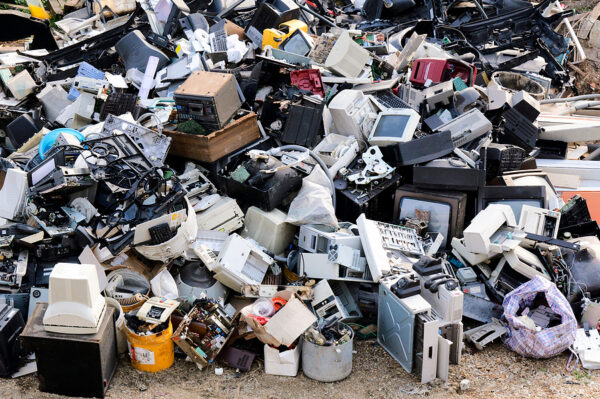
With more than 50 years of research and major strides in managing the chemicals, metals, and other pollutants that come from advancing technology, you’d think tech companies would carefully consider the environmental impact before rushing headfirst into something new. The reality is that despite moves toward a circular economy and environmental responsibility, initial estimates of AI e-waste are inaccurate.
A recent report from the Basel Action Network (BAN) shows that by 2030, AI e-waste will be 40 to 60 times higher than initial estimates. The resources needed to handle this e-waste aren’t in place. While specialists can accept and break down electronics used by data centers worldwide, they likely can’t handle the required volume.
Businesses and consumers used to throw broken or old electronic equipment into the trash. All of that metal, glass, plastic, and other contaminants sit in the landfill soil, slowly breaking down and leaching chemicals and metals into the ground for decades.
The reality is that it’s impossible to tell how many centuries it would take for the plastic, metal, and glass from a computer to break down. U.S. landfills were upgraded with HDPE liners over packed clay in 1991, and additional monitoring systems were installed to ensure that the leachate formed during decomposition doesn’t enter water supplies deep underground.
It’s hard to tell exactly how long these liners will last. What will things look like 200 years from now? Detectorists today dig up old coins, horseshoes, guns, and farm tools. Will they be finding old hard drives 300 years from now? How much waste will have leached into the soil and groundwater?
Past generations have undeniably caused damage by disposing of appliances or failing to think through common daily habits. Lead is found in soil because of leaded gasoline in cars and farm equipment, paints, pesticides, and industrial practices. We understand the dangers of lead now. The AI e-waste surge is something we also need to weigh heavily and approach cautiously.
What’s Driving the AI E-Waste Surge?
The rise of AI has created a flurry of activity as electronic equipment is replaced or stops working. Past studies have focused on servers and graphics processing units (GPUs) when estimating potential e-waste. They only account for 13% of the electronic items found within a data center.
If you look at the number of electronic components within a data center, the list is incredible. The actual inventory depends on the data center’s size and role. Expect to find:
- AI server racks
- Centralized storage systems
- Cooling systems, chillers, and immersion cooling tanks
- Fiber optic cables
- High-bandwidth memory SSDs
- Low-latency, ultra-high-bandwidth switches
- On-site substations and transformers
- Screens or monitors
- Standby generators
- Switchgear and busways for high amperage
- UPS batteries
This equipment runs all day, every day, and often at maximum capacity, so it experiences more thermal stress and wear. It won’t last as long as your office computers. Most data centers replace their equipment within three years. It doesn’t get the five to seven years that might occur in a business.
When you have hundreds or thousands of switches, SSDs, etc. wearing out every three years, it becomes clear why AI-related e-waste will become a massive problem. Used electronics enter the waste stream, and new components also drive huge demand for raw materials and rare earth minerals.
BAN’s study reports that up to 13.1 million tonnes (14.4 million U.S. short tons) of AI data center electronics could be recycled every year by 2030. U.S. e-waste recyclers need to be ready for that kind of demand. Data center owners need to do their part, too.
Explore Its Impact on the Environment and Critical Materials
Every server rack in a data center has rack-mounted hardware, power distribution and redundant power supplies, networking connections, switches, cooling systems, and the ability to monitor the equipment remotely, so you have to also think about a smartphone or laptop that’s part of the system.
The computer chips alone contain aluminum, copper, gallium, germanium, gold, silicon, and tantalum. They can also have:
- Cerium oxide
- Dysprosium
- Lanthanum
- Neodymium
- Praseodymium
China holds and processes the largest amount of gallium and germanium, and the country announced strict export limits in 2023. Until then, it supplied all the rare earth minerals the U.S. used.
While the U.S. can process and refine rare earth minerals domestically, it would take more than 15 years to build the necessary infrastructure. Recycling rare earth minerals is a smarter option, though only about 1% are currently recovered from end-of-life electronics.
Recycling avoids the high cost and potential radiation exposure of mining. You also avoid increased habitat destruction and toxic waste production. The only downside is that the chemical separation isn’t as cost-effective as some want.
Aren’t Regulations, Policies, and Infrastructure Ready for the Surge?
With tremendous e-waste being generated, there must be enough ITAD specialists to support the volume of retired electronics. One concern is that some electronics recyclers still send old electronics to developing countries. Overseas nations end up with waste that is harming workers, communities, and the environment.
When an ITAD/e-waste specialist is certified in both e-Stewards and R2, it commits to keeping all retired electronics in the U.S. Nothing goes overseas. Some e-Stewards-certified recyclers are struggling to recycle plastics. Plastic waste exports to countries like Indonesia, Malaysia, Thailand, the United Arab Emirates, and Vietnam have increased.
In one case, a company shipped more than 60,000 metric tons of waste to developing countries. It often comes down to brokers not paying close attention to their downstream vendors. Work with ITAD and e-waste recyclers that carefully vet all downstream vendors and partners.
How Can Business Owners and Decision Makers Prepare?
In the words of the Basel Action Network’s Founder and Chief of Strategic Direction, “Technology companies must take steps now to develop a budget, new infrastructure, and a plan to mitigate the AI toxic waste wave.”
As the owner or decision-maker of a technology company, pause and review all equipment purchases and upgrades before you buy anything. Make smart purchases with equipment known to outlast the competition. Inventory all electronics and establish an end-of-life plan.
When a component is no longer useful to you, it could be incredibly useful to a smaller organization. Partner with an R2- and e-Stewards-certified vendor that guarantees transparency and offers real-time tracking so you always know where your electronics are. Once data is deleted, the items are sold to new organizations.
Harvesting viable parts for future repairs is another way to support a circular economy focused on reducing, reusing, and recycling. ERI can help you responsibly recycle anything left over and ensure data is erased to government standards before you sell or redistribute it.